

 Made with Levo
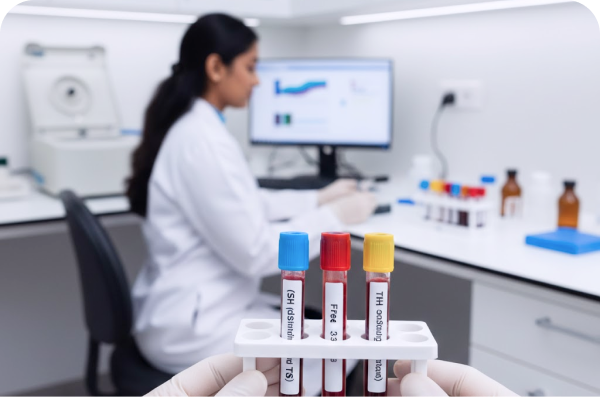




Comprehensive Thyroid Function Panel (T3, T4, and TSH)
The Comprehensive Thyroid Function Panel is a set of blood tests used to evaluate how well your thyroid gland is working. This panel typically measures three key hormones: Thyroxine (T4), Triiodothyronine (T3), and Thyroid-Stimulating Hormone (TSH). Because these hormones regulate metabolism, energy levels, body temperature, and the function of many organs, measuring them provides an important snapshot of your endocrine health.
What is being measured?
1. Thyroid-Stimulating Hormone (TSH)
TSH is produced by the pituitary gland in the brain. Its main role is to stimulate the thyroid gland to produce and release T4 and T3. It is often the first and most sensitive test used to detect thyroid problems.
High TSH levels usually indicate an underactive thyroid (hypothyroidism). This means the pituitary gland is working harder to push a sluggish thyroid to make more hormones.
Low TSH levels often suggest an overactive thyroid (hyperthyroidism). In this case, the thyroid is producing too much hormone, so the pituitary reduces TSH production in response.
2. Thyroxine (T4)
T4 is the main hormone produced by the thyroid gland. Most T4 travels in the blood attached to proteins, but the active portion is called free T4. A T4 test measures how much of this hormone is circulating in your blood. T4 plays a key role in regulating metabolism, weight, and energy levels.
3. Triiodothyronine (T3)
T3 is the other major thyroid hormone and is more potent than T4. The thyroid produces some T3 directly, but much of it is formed when T4 is converted to T3 in other tissues of the body. T3 also exists in bound and free forms. A T3 test is often used to diagnose hyperthyroidism or to assess how severe it is.
Why is this combination test ordered?
A combined T3, T4, and TSH panel helps doctors understand the full feedback loop that controls thyroid function. It is commonly ordered for:
Diagnosis of thyroid disorders: Helps identify hypothyroidism (underactive thyroid) and hyperthyroidism (overactive thyroid).
Monitoring treatment: For patients already on thyroid medication (such as levothyroxine), this panel helps monitor hormone levels and adjust doses to keep them in the target range.
Investigating symptoms: Often ordered when a person has symptoms like unexplained weight gain or loss, fatigue, anxiety, depression, sensitivity to cold or heat, hair loss, or changes in heart rate.
How to prepare for the test
Preparation is usually simple, but a few points are important:
Medication review: Inform your healthcare provider about all medications and supplements. Some drugs, like certain birth control pills, steroid medicines, and supplements containing biotin, can affect results. You may be advised to stop biotin for 2 to 3 days before testing.
Fasting: Fasting is usually not required, but follow your doctor’s instructions, especially if other blood tests are being done at the same time.
Timing of thyroid medication: If you take thyroid replacement medicine, your doctor may recommend doing the blood test before your morning dose.
Interpreting your results
All three values are interpreted together, as changes in one hormone affect the others. Exact reference ranges vary by lab, but common patterns include:
Hypothyroidism (underactive thyroid):
TSH: High
Free T4: Low
Free T3: Low or normal
Hyperthyroidism (overactive thyroid):
TSH: Low
Free T4: High
Free T3: High
Subclinical hypothyroidism:
TSH: High
Free T4: Normal
Free T3: Normal
Subclinical hyperthyroidism:
TSH: Low
Free T4: Normal
Free T3: Normal
If your results are abnormal, your doctor may advise further tests, such as thyroid antibody tests or a thyroid ultrasound, to identify the exact cause of the thyroid problem.
Frequently Asked Questions (FAQs)
1. What is the purpose of the Thyroid Profile test?
The purpose is to evaluate the function of the thyroid gland, diagnose thyroid disorders (like hyper or hypothyroidism), and monitor the effectiveness of ongoing thyroid treatments.
2. What is considered a normal TSH range?
The normal TSH range for non-pregnant adults is typically around 0.5 to 4.5 or 5.0 μIU/mL, but this can vary slightly between labs. Your doctor will use specific ranges if you are pregnant or being treated for a thyroid condition.
3. Can stress affect my thyroid test results?
Yes, chronic, high stress can potentially influence the hormonal axis that controls thyroid function, sometimes leading to subtle changes in results. Acute illness (non-thyroidal illness) can also significantly alter results.
4. Can I get the thyroid profile done at home?
Yes, you can get this test done at home. Tapadia Diagnostic offers safe and convenient home sample collection, making the process easy and hassle-free.