Made with Levo





Whole Exome Sequencing sequences all 20,000 protein-coding genes (~2% genome) identifying rare variants (SNVs, indels, CNVs, mtDNA) causing undiagnosed disorders.
High coverage 120x nuclear/2000x mtDNA, low error 0.1%, TAT 4 weeks. Kanopy NGS excels uniformity.
Recommended for pediatric neurology, developmental delay, dysmorphic syndromes post normal karyotype. Genetic counseling integral.

Why Is This Test Recommended?
You may need this test to:
Diagnose rare Mendelian disorders (yield 30-50%)
Guide precision therapy e.g., enzyme replacement
Family trio sequencing for inheritance
Complex phenotypes like neuro-metabolic
Hereditary cancers/ cardiomyopathies
Symptoms or Conditions That May Require WES
You may need this test if experiencing:
Unexplained seizures, developmental delay
Multi-system failure unexplained
Recurrent miscarriages/infant deaths
Dysmorphic features/consanguinity
Drug-resistant epilepsy
Why do I need a WES test?
Ends diagnostic odyssey for 1/3 families, enables targeted treatment averting progression.
How Do I Prepare for WES?
Genetic counseling pre-test essential.
No fasting; collect 3-5mL blood 2 EDTA vials.
Family samples (trio) improve interpretation.
Consent for incidental findings.
How Is WES Performed?
Phlebotomy room collection:
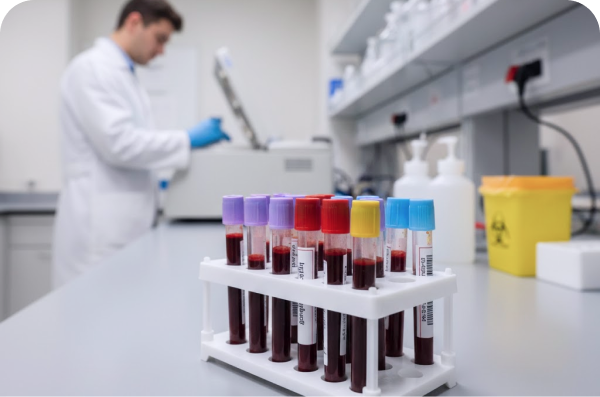
Disinfect site, draw blood into purple-top tubes.
Freeze/ship to NGS lab (Kanopy automated).
Bioinformatics pipeline variant calling ACMG classified.
Expert review, report 4 weeks.

What Happens After the Test?
Counseling session interprets variants.
Resume normalcy; store sample future.
Digital report with VUS list.
When Should I Consult After Test?
Pathogenic variant found.
Actionable secondary findings.
Reanalysis request post new symptoms.
Advantages
- Covers >20,000 genes + full mitochondrial genome.
- ~10 GB data/sample for high coverage and accuracy.
- Clinically validated pipeline with expert review.
- Uniform coverage across GC-rich and repetitive regions.
- Enhanced detection of SNVs, indels, and mtDNA variants.
- High signal-to-noise ratio → improved variant confidence.
- Mean Coverage: ≥ 120× for nuclear exome, ≥ 2000× for mitochondrial genome.
- Uniformity: ≥ 95% bases covered at ≥ 20×.
- Variant Call Precision: > 99% for SNVs, > 95% for indels.
- Q30 ≥ 92%.
- Duplication Rate < 1%.
Lifestyle Tips
Join support groups post-diagnosis.
A healthy diet aids in some metabolic processes.
Regular follow-up genetics clinic.
What Does WES Measure?
~23,000 exons, mtDNA heteroplasmy.
Precision 99% SNVs, CNV detection.
GC bias negligible unlike others.
What Do Results Mean?
Pathogenic: Diagnosis confirmed.
Likely pathogenic: High confidence.
VUS: Monitor/ reclassify later.
What If Results Abnormal?
Targeted Rx, clinical trials.
Prenatal/family testing cascade.
Can Results Affected By?
Poor DNA quality, mosaicism limits.
Factors Affecting WES
Sample age/handling degrades.
Parental mosaicism confounds.
Population databases bias.
Frequently Asked Questions (FAQs)
Is fasting required?
No - fasting is not required; both the proband and the unaffected parent may eat and drink normally before blood collection.Why is only one parent's sample required in UP-OS?
The UP-OS configuration is used when only one biological parent is available, accessible, or willing to participate. Including even one parent's sample significantly improves diagnostic yield over proband-only testing by enabling comparative variant analysis.How is UP-OS WES different from Trio WES?
The standard WES is a trio analysis that includes the proband and both parents. However, a duo analysis (UP-OS) is available and includes samples from the proband and one parent.
Trio WES offers the highest diagnostic yield and the most complete inheritance pattern analysis; Duo/UP-OS is the best available alternative when only one parent can participate.What if no causative variant is found?
A negative WES result does not exclude a genetic cause.
The laboratory may recommend reanalysis of the existing data after a 12–18 month interval as new genes are discovered and variant databases are updated, or consider escalation to Whole Genome Sequencing.Can WES detect all types of genetic mutations?
No - WES is highly sensitive for SNVs, small InDels, and CNVs within the exome, but does not reliably detect large chromosomal rearrangements, repeat expansions, epigenetic changes, or deep intronic mutations. Complementary tests may be needed to cover these variant types.Is post-test genetic counselling mandatory?
While not always legally mandated, post-test genetic counselling is strongly recommended as an essential component of responsible WES practice to ensure results are accurately understood, appropriately acted upon, and sensitively communicated to the entire family.